
By Courtney Caputo.
The term “dark sky city” might sound like an oxymoron, but across Arizona, communities are proving that it’s possible to promote urban growth while maintaining starry night skies. In 2001, Flagstaff, Arizona, was named the first ever international dark sky city thanks to its fifty-year history of enacting policies to combat light pollution. Since then, the International Dark Sky Alliance has certified Sedona, Camp Verde, Village of Oak Creek, Cottonwood, Fountain Hills, Bisbee, and Tubac as dark sky places. Ultimately, Arizona has more certified dark sky places than anywhere else in the United States.
This blog discusses why Arizona communities have chosen to regulate light pollution, provides a case study that illustrates how dark sky zoning works in practice, and suggests that other Arizona municipalities could benefit from adopting dark sky policies.
Why Combat Light Pollution? If you’ve ever seen the ethereal night skies at the Grand Canyon, you already know one reason why so many Arizona communities choose dark sky regulations: stars are awesome! But preventing light pollution also offers ecological, health, and economic benefits.
First, many species evolved to depend on dark skies. For example, bats wait until dark to hunt in order to avoid predators. When darkness never comes, however, bats sometimes wait indefinitely in their caves, even if it means starving to death. Light pollution can also deprive plants of crucial rest time by inducing them to photosynthesize throughout the night. This disruption to plants’ natural cycle is especially concerning for the numerous plants in the Arizona desert that flower at night.
Humans also evolved to expect dark nights. While it’s difficult to isolate the effects of light pollution alone (as opposed to artificial light from our phones and other sources), research shows that increased exposure to artificial light can affect melatonin production. Reduced melatonin levels are linked to sleep deprivation, anxiety, and even cancer.
Finally, reducing light pollution is economically beneficial. Unnecessary outdoor lighting costs American communities about $3.3 billion per year in energy costs and generates about 21 million tons of carbon dioxide annually. By contrast, Arizona’s dark skies attract astronomy investments: Arizona is home to Lowell Observatory (where Pluto was discovered), the United States Naval Observatory (“the authoritative source for the positions and motion of celestial bodies, motions of the Earth, and precise time”), and the Mount Graham International Observatory (the world’s largest public telescope). The University of Arizona’s space science activities, made possible due to several dark sky parks near Tucson, generate about $560 million per year. Additionally, Flagstaff has identified astronomy as a priority sector that can attract students (and, therefore, their tuition dollars) to Northern Arizona University and create high-paying employment opportunities.
Thus, the benefits of a pristine night sky make dark sky regulations appealing. The next section considers how a city might structure its policies to achieve these benefits.
How Do Dark Sky Regulations Work?
As the first city to achieve dark sky certification and the most populous dark sky city in Arizona, Flagstaff provides an interesting case study on how to implement dark sky zoning without sacrificing municipal development. Division 10-50.70 of the Flagstaff City Code establishes strict lighting standards for almost all structures in the city. The ordinance sets maximum limits on total light output and specifies when the City requires shielding (i.e., using a barrier to block light disbursement, as illustrated below). Violating the ordinance is a misdemeanor, with each day of illegal “erection, maintenance, and use” constituting a separate offense.
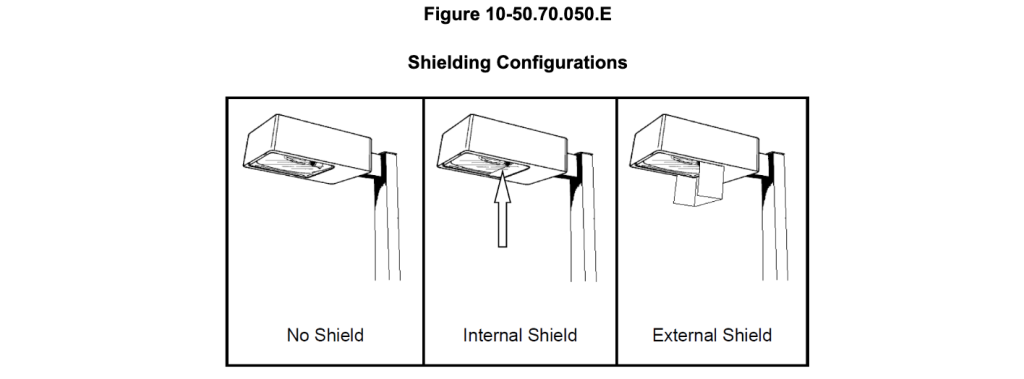
An illustration from the Flagstaff City Code showing lights with internal shields (i.e., barriers built into the light) and external shields (i.e., physical structures separate from the light). The code permits both types of shields. Shielding focuses light in its intended direction—downward, in the streetlight example above—and blocks light disbursement in unintended directions—upward or outward, in the example above.
The code requires different lighting standards categorized by zone, class of lighting, and development type.
Zone
Flagstaff’s two lighting zones are defined by their proximity to the Kaj Strand telescope at the U.S. Naval Observatory, which is the U.S. Navy’s largest telescope. In the area within 2.5 miles of the telescope (Lighting Zone 1), the code heavily restricts artificial light. In all other municipal areas (Lighting Zone 2), the code permits higher light output. Thus, Flagstaff’s dark sky zoning is structured around the research opportunities dark skies provide.
Class
The code further distinguishes between different lighting purposes. Class 1 Lighting is “lighting used for applications where color rendition is required to preserve the effectiveness of an activity,” which includes commercial lighting for outdoor eating areas, recreational areas, and signage. The code permits this lighting, but it restricts the permitted level of heat for Class 1 lights, requires Class 1 lights to be shielded, and requires Class 1 lights to be turned off 30 minutes after a business closes. This classification balances Flagstaff’s dark sky goals with the reality that some urban activities require bright, colorful lighting.
Class 2 includes lighting “where general illumination for safety or security is the primary concern,” such as in parking lots. Like Class 1 lights, Class 2 lights must be fully shielded. However, Class 2 lights can remain on after a business closes to promote safety. Class 2 lights must be narrow-spectrum LEDs, which is a more restrictive requirement than in Class 1. Additionally, light restrictions do not apply at all when other public safety concerns are present, such as when law enforcement deems it necessary to use high-intensity searchlights. Thus, the ordinance clearly prioritizes public safety over perfectly dark night skies.
Finally, Class 3 lighting is decorative lighting, like architectural illumination. The ordinance only permits Class 3 lighting with a very low light output. However, unlike Class 1 and 2 lighting, Class 3 lighting in Zone 2 is not required to be shielded—likely because shielding would diminish the decorative effect of certain lighting structures. The fact that lighting in Class 3 is much less necessary than in Classes 1 and 2 shows that a certified dark sky city doesn’t need to sacrifice all “just for fun” nighttime lighting.
Development Type
The code also distinguishes between “Commercial, Industrial, and Multiple-Family Developments” and “Single-Family and Duplex Developments, Including Accessory Structures.” The former is permitted significantly more lumens per acre than the latter, demonstrating a commitment to attracting commercial activity to the city. However, lighting for the latter category in Zone 2 (i.e., away from the Kaj Strand telescope) is not required to be shielded, while all commercial lighting must be shielded. This benefits residents because the initial cost for shielded lights is generally higher than non-shielded lights (although shielded lights are more cost-effective in the long run). Therefore, the ordinance does not impose mandatory up-front costs on families illuminating their homes unless they live within the narrowly defined research zone.
In sum, this regulatory framework balances municipal needs like attracting business, ensuring residents’ safety, and enjoying decorative lights with the need to keep Flagstaff’s skies dark. Through this balancing, Flagstaff offers a great example for other cities seeking to adopt dark sky regulations while also building strong and safe communities.
Opportunities for Other Arizona Cities?
Although Fountain Hills’ 2018 dark sky certification exemplifies how dark sky policies can be implemented in the Phoenix Metro Area, no other Phoenix-area municipalities have adopted dark sky policies. Yet, dark sky policies could be an excellent choice for Arizona cities like Chandler or Gilbert. The allure of dark skies could attract more residents, improve health outcomes for existing residents, and support local wildlife. Meanwhile, dark sky policies would not significantly harm the cities’ urban activities: there are dark-sky friendly ways to build sports stadiums, display billboards, and light major industrial or community areas.
Finally, as an alternative to piecemeal local zoning, Arizona’s legislature could consider adopting statewide dark sky policies. Doing so could transform Arizona into the first dark sky state—a fitting accomplishment for the home of the world’s first dark sky city.

Courtney is a second-year law student with professional interests in commercial litigation. Courtney is a Staff Writer for the Arizona State Law Journal and serves on the executive board of ASU’s Business Legal Assistance Program. Before attending law school, she earned her B.A. and M.A. in English (Writing, Rhetoric, and Literacies) from Arizona State University. Courtney has professional experience in several technical writing and research roles. In her free time, Courtney enjoys reading and cooking.