
By Abigail Gass.
On January 7, 2026, Taiwan Semiconductor Manufacturing Company (TSMC) bid $197.25 million for 902 acres of state trust land in North Phoenix—matching the appraised “true value” and not a dollar more. The public auction had no other bidders. In less than five minutes, the world’s largest chipmaker acquired a square mile of Arizona desert at the statutory minimum price.
Arizona holds roughly 9.2 million acres in trust for the benefit of designated public institutions, with K-12 public schools as the primary beneficiary. The Arizona State Land Department (ASLD) manages this land as trustee and owes the beneficiaries a fiduciary duty to act in their best financial interest. Both federal and state law impose safeguards to ensure the ASLD fulfills its duty. First, Section 28 of the Arizona-New Mexico Enabling Act of 1910 requires the ASLD to sell trust land through a public auction to the highest bidder for no less than the appraised value. Second, Article X of the Arizona Constitution requires the ASLD to maximize the financial return to beneficiaries. The Arizona Supreme Court has described this as “two complementary levels of protection against improvident state legislative or executive disposal of Arizona’s school trust land.”
But when there is only one bidder, does the public auction still serve the trust, or does it undermine the ASLD’s fiduciary duty to maximize value for its beneficiaries?
Arizona’s Trust Land Framework
Congress imposed these requirements because other states have “improvidently leased and sold their lands with little or no benefit to the public schools.” A public auction would encourage competitive bidding, and competitive bidding would produce price discovery. This logic worked in 1910, when buyers were ranchers and homesteaders bidding on modest parcels.
But while other Western trust land states have modernized their frameworks, Arizona has not. New Mexico’s Land Commissioner can negotiate non-bid commercial and industrial leases with buyers. Colorado’s State Land Board issues long-term commercial ground leases, enters public-private partnerships, and acquires income-producing properties to diversify its portfolio. Texas manages 13 million acres through the General Land Office, which leases trust land for commercial development, renewable energy, and oil and gas production. Yet, the Arizona State Land Department still has only one tool for trust land sales: the public auction.
The Single Bidder Problem
Single-bid auctions for large-scale industrial trust land are not unusual for Arizona. In December 2020, TSMC acquired 1,129 acres through another ASLD auction as the sole bidder, paying the appraised value of $89 million.
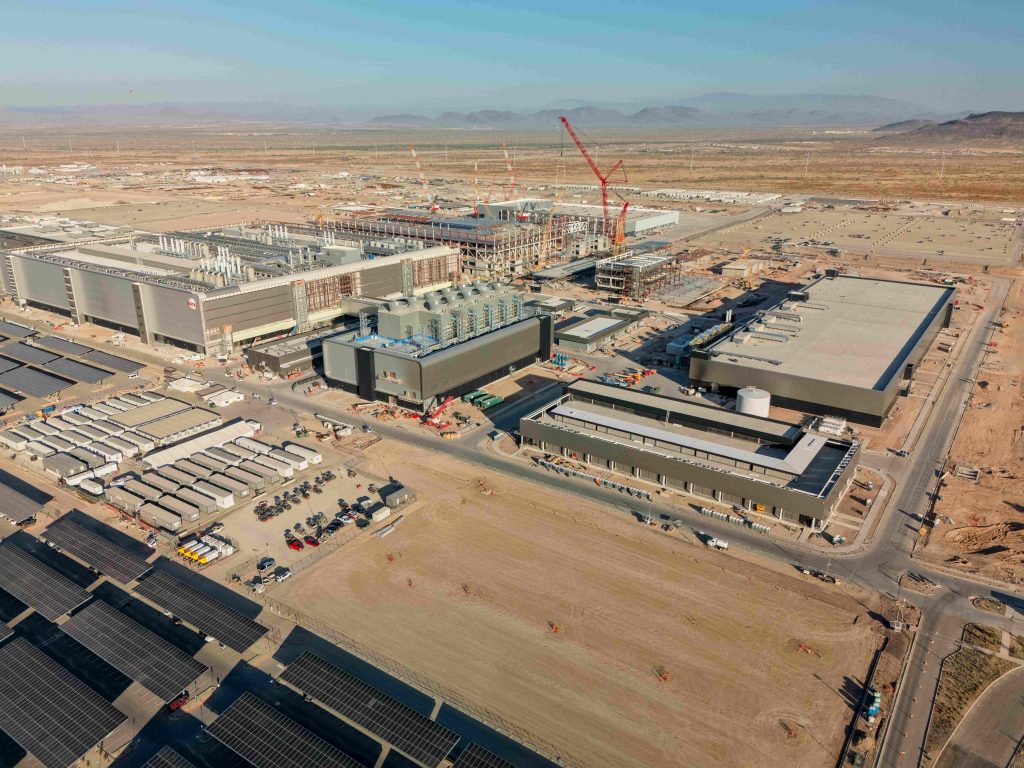
Semiconductor manufacturing at this scale requires extraordinary infrastructure, including a sustainable water supply, high-capacity electrical service, and specialized transport access. This effectively limits where TSMC can expand. In December 2025, the Phoenix City Council approved rezoning for the “NorthPark” project, facilitating the expansion of TSMC’s plans for three new fabrication plants, two advanced packaging facilities, and a research and development center. The 902-acre parcel for sale is situated immediately south of TSMC’s existing Gigafab campus. By auction day, the land had been appraised, rezoned, and positioned as an extension of one company’s campus.
TSMC was the highest-value user of this land, and probably the only realistic buyer. Is there a potential buyer who would have thought they could outbid TSMC? The winning bidder was required to assume roughly $250 million in infrastructure obligations, including major roadway expansion and water and waste improvements. For TSMC, with $65 billion already invested in this project and $6.6 billion secured in funding under the CHIPS Act, that cost is a line item. Add a $55.9 million cashier’s check to register, 25% of the appraised value due at the close of bidding, and the full balance owed within thirty days, and the auction was over before it started.
Deer Valley and the Fiduciary Duty to Maximize Value
The Arizona Supreme Court established the standard for the fiduciary duty to maximize value in Deer Valley Unified School District v. Superior Court. In Deer Valley, a school district sought to condemn a parcel of state trust land. The ASLD refused, believing future commercial leases would yield higher returns. The court agreed, holding that Article X “establishes [an] independent fiduciary obligation to manage state lands in the best interest of the trust.” Condemnation at the appraised value, the court concluded, would “deprive the Department of the opportunity to obtain a price higher than the appraised value” and “hinder the Department’s obligation to manage and maximize the trust benefits.”
The logic of Deer Valley cuts directly against the TSMC auction. If accepting the appraised value through condemnation was insufficient because the market might bear more, then accepting the appraised value from a single bidder raises the same concern. Granted, ASLD reserves the right to reject bids it deems unacceptable. But turning down a $197 million offer from the company behind the largest foreign direct investment in U.S. history, with no reason to expect that a second auction would draw more bidders, was never a realistic option.
Revenue Implications for the Permanent Fund
This land is worth more to TSMC than to any other bidder because it adjoins its existing campus. That adjacency creates a buyer-specific premium that standard appraisal cannot calculate. If the public auction cannot capture that premium, the result sits uneasily with ASLD’s fiduciary duty to maximize trust returns.
On the other hand, ASLD has argued that “the primary reason that many auctions only have one bidder is that the appraisal price is correct and no other bidder is willing to pay more than the [fair market] price.” But it’s important to note that the process itself discourages competition. Former Speaker of the Arizona House of Representatives Rusty Bowers called a similar large-scale ASLD auction “rigged to benefit one particular company, or at least a very, very small subset of companies.”
When the ASLD sells trust land, the State Treasurer deposits the proceeds into the Permanent Land Endowment Trust Fund. The fund preserves the principal in perpetuity and distributes the investment earnings to beneficiaries. So, schools do not receive the $197 million bid. They receive the annual return generated by $197 million. Thus, any shortfall in the sale price is a recurring, compounding loss that diminishes distributions to the beneficiaries indefinitely. Because the fund operates like an endowment, even a relatively small difference in price can compound into a substantial loss over time.
Conclusion
None of this is to suggest that the TSMC sale was a bad outcome for Arizona. The company has committed up to $165 billion in investment for expansion, and Phoenix’s emergence as the “Silicon Desert” is projected to generate tens of thousands of construction and tech manufacturing jobs. A company building the largest foreign direct investment in American history on the adjacent parcel was never going to be outbid, and Arizona had every reason to want it as a buyer.
The TSMC auction is worth examining not because it went wrong, but because it worked exactly as the system was designed. Arizona still holds more than 9.2 million acres of trust land available for sale. How that land is sold will shape public school funding for generations.

Abigail Gass is a 2L at the Sandra Day O’Connor College of Law, where she serves as a Certified Limited Practice Student in the Civil Litigation Clinic and an extern at the Arizona Court of Appeals. Before law school, Abigail earned her B.A. in Law with a minor in Psychology from the University of Arizona. This summer, she will be a Summer Associate at a Phoenix law firm, where she looks forward to exploring her interest in litigation. In her free time, Abigail enjoys reading books and working out.