
By Tiberius Hernandez.
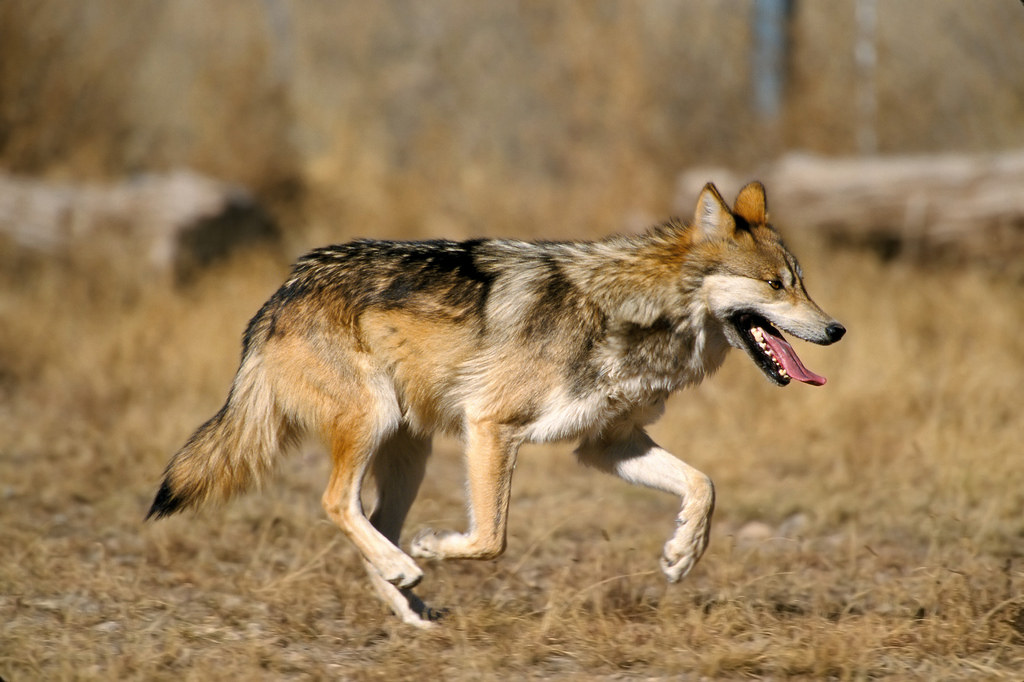
To many, the term “wolf” evokes an image of a large canine trudging through dense forest, tall trees, and powdery snow. Although such depictions seemingly dominate our media, many would be surprised to know that the American southwest was once home to a thriving wolf population of its own. Originally known by names such Cuetzlachcojotl, Shee’e, ba’cho, ma’cho, or Ma’iitsoh, the Mexican Wolf (canis lupus baileyi) once thrived in a region that spanned from west Texas to southeast Arizona, extended as far north as tip of Utah, and went as far south as the Mexican state of Oaxaca. However, human activities have left the Mexican Wolf population devastated, and yet the Arizona legislature is actively seeking to roll back protections for this beautiful creature as it begins to recover.
In the 1800s, the westward movement of European settlers posed a twofold existential threat to the Mexican Wolf population. Unregulated hunting of large game and rampant large-scale cattle grazing operations eliminated much of the Mexican Wolf’s usual food sources. Eliminating so much of their usual food sources forced the remaining Mexican Wolf population to hunt domestic livestock as prey, drawing the ire of the developing livestock lobby. Following pressure from livestock interests, Congress created the Predatory Animal and Rodent Control Service in 1915 with the mission of eradicating wolf populations nationwide—including the Mexican Wolf. By 1976, the Mexican wolf was classified as an endangered species. Currently, an estimated 319 Mexican wolves remain in Arizona and New Mexico.
In the early stages of the 2026 legislative session, several bills have been introduced that are intended to roll back protections for the Mexican Wolf. House Concurrent Memorial 2011 (H.C.M. 2011) is a Concurrent Memorial that requests that the United States Congress delists the Mexican Wolf as an endangered species under the Endangered Species Act (“ESA”). H.B. 2159 would require the Arizona Game and Fish Department to issue private landowners a “taking permit” that allows the “taking” of Mexican Wolves on their private property, in addition to requiring such permits be issued to individuals leasing state lands for grazing purposes. Critically, permission to “take” an animal under Arizona law includes permission to hunt the animal. H.B. 2158 would have classified wolves as “predatory animals,” a category that includes some animals (such as bears) that are managed as big game, although this bill was later amended to remove reference to wolves. H.B. 2787 prohibits the state from funding compliance with the Mexican Wolf reintroduction program initiated pursuant to the ESA.
Sponsors of the bills primarily cite ranchers’ and farmers’ concerns about Mexican Wolves attacking livestock as driving the legislation. In 2024, the United States Fish & Wildlife Service confirmed that Mexican Wolves killed twenty-four cattle in Arizona. For reference, the Arizona Beef Council reports that there are about 930,000 cattle and calves in Arizona.
However, it is worth noting that in the aggregate, wolf attacks on cattle herds can have an outsized impact on ranchers. A recent study conducted by the University of Arizona indicates that the killing of calves by Mexican Wolves can actually have a year-over-year negative effect on revenue for the rancher. The lowest estimate modeled by the study indicates that if Mexican Wolves kill just 2% of the calves in a herd of 367 cattle, the rancher would stand to lose more than $5,000 in annual revenue. Lawmakers who support removing Mexican Wolf protections posit the damages to ranchers exceeds hundreds of thousands of dollars.
Proponents of the anti-wolf legislation also point to the success of Mexican Wolf conservation programs. As noted above, the most recent official count for Mexican Wolves in the southwest (New Mexico and Arizona) is 319, up from 286 in 2024. This is significant, because under current guidelines, Mexican Wolves can be “downlisted” from endangered to threatened if Mexican Wolves average 320 individuals over a four year period. Advocates to remove Mexican Wolf protections have pointed to these statistics and argued that the reintroduction programs have worked, so now landowners must be able to take action against Mexican Wolves without any hindrance from environmental laws.
Environmental activists have opposed these measures as premature at best. When speaking to local news outlets, a local leader of the Sierra Club articulated that the statistics show that the Mexican Wolf population has “hardly recovered,” arguing that any weakening of protections now would just return the wolf populations to dangerously low numbers.
Plenty have also critiqued this legislation on political grounds. While H.C.M. 2011’s request to have Congress delist the Mexican Wolf is not binding in any way, the other pieces of legislation pose possible issues with Federal preemption. Specifically, by permitting landowners to “take” Mexican Wolves, H.B. 2159 would effectively allow landowners to hunt species protected by the ESA, which explicitly contravenes federal law. As Arizona legislators have pointed out, this would almost certainly force state taxpayers to foot the bill for a losing lawsuit.
While losing cattle is a real issue for ranchers, these sweeping efforts to remove Mexican Wolf protections are too much too soon. The population target of 320 in the United States was backed by scientific research and provides a strong baseline for a healthy population. Removing protections now that the Mexican Wolf population is just below the threshold would only serve to set back the population to even lower levels, pushing the species closer to extinction.
Furthermore, rejecting these protection roll-backs is the most prudent option for the Arizona legislature. Moving forward with a state law that blatantly contradicts the ESA only opens the door for unsuccessful litigation that taxpayers will ultimately pay for. Moreover, federal programs already exist to compensate ranchers for livestock lost to federally protected wild predators.
Ultimately, while there may come a time when the Mexican Wolf is plentiful enough that legislators may safely remove some of its protections, that time has not yet come. The Arizona legislature must continue to protect these majestic creatures and reject these premature measures that could devastate the Mexican Wolf population.
Awoooooooooooo

Tiberius is a 2L originally from Bakersfield, California. Tiberius is interested in international trade and supply chains. In his free time, Tiberius enjoys backpacking, climbing, and playing volleyball.